Thứ Hai, 27 tháng 2, 2017

Highlight dish in Vietnam


Sapa mushroom:
• At the Sapa market any season, you are invited buy dried mushrooms, is the specialty of the mountainous in Sa Pa. At the restaurant, you can ask to eat mushrooms. Dried mushrooms soaked in water, will swell but it is still remain scent of mountain land, taste of forest trees. As a gourmet, you can request a restaurant to eat mushrooms foot. That body shredded mushrooms fried with meat , add some dried squid dotted and spices , then feast your target disk would have usurped the next class of watercress salad , chayote , mountain cabbage , cabbage , kohlrabi ... have created your very own Sapa. As soon as the vegetables here are also being considered as fresh vegetables, for her children retain the traditional cultivation method.Top tips to buy souvenirs in Vietnam
Grilled pork noodles 

Grilled pork with noodles is a popular dish that a lot of places also have a delicious dish with some different flavor. If you have a chance to enjoy, you should eat this delicious food.
There are many ways to do noodles delicious kebabs and most important is sewn marinades. If you marinate meat, there will be a delicious bowl of delicious noodles.
How to do barbecue noodle dish is very popular and very popular in the capital city by the same taste delicious barbecue sauce is very charm. By doing a simple steak noodle dish you could do to entertain family members. The unique cuisine in Hoian

Tam Ky chicken rice
We can see the yellow of the chicken broth cover in the rice and the rice has a beautiful yellow color. The chicken meat is steamed in the stove with some salt, scallion, herb…. to have a specific aromatic. The sauce is used with “Tam Ky” rice chicken is the sauce with the spicy of chilli, the source of minced lemon, the sweet of sugar. All of this mix with fish sauce to have perfect sauce. Retired Air ginger very fine sugar, fish sauce, chili for slightly sweet, salty concentrate. When we eat, we put ginger sauce into the rice, served with chicken and rice.

It is delicious and beautiful dish
Shredded chicken, put to pepper, salt, seasoning salt, a few drops of lemon juice and mix well to coat spices. When we close to eat, mix onion, laksa leaves, herbs, non- gold pilgrims into rice and enjoy.

Sa Dec Noodles 

To eat this type of noodles, customers can call the meat, bone dry or preferences. Meat and bone are processed in this article remain soft, delicious. Soup is available spices like MSG, sugar, salt ... that is tunnel from pork bones.
Steaming bowl of noodle of their orders, as well as at the customers took a deep breath to feel the taste of food in the air dryer. In the bowl of noodles, meat apart with your stomach, heart, liver ... To enjoy and feel the flavor blending in the mouth, many people can put more fish sauce, soy sauce, or little vinegar, chili with live prices.

About 800m central beach area Dao Garden, it focused midrange hotel restaurant that many travel groups choose when to Bai Chay. If you stay here, just walking down the street is able to enjoy seafood in the restaurants next door. However, due close to downtown so the price here is still quite high.

For those travelers who travel Halong at obvious time, they often look to the seafood restaurant across town. That's sidewalk cafes on coastal embankments in the area of ​​Ben Doan, Bai Chay by about one kilometer. From far away you can smell the fragrance nose tingle of oysters, clams, snails baked. Call sip a beer and oyster plate with baked milk, will not have anything more wonderful when you enjoy the salty sea in windy bouts. Rustic style at affordable prices is a plus that many whisper travelers to this place.

Thứ Năm, 23 tháng 2, 2017

Top 5 boats in Mekong delta


RV Jahan cruise
Comprising a large library where tourists can spend their leisure time reading books or magazines and a spacious lounge with soft sofas, the observatory provides a stunning view of wonderful scenery on Mekong River. A special dinner can be served at the observatory to meet your demand to create a romantic experience for your trip in Mekong Delta. Walking around Ho Guom in the morning peace

Gorgeous view
Situated on the spacious pool deck decorated with giant glass windows which are easy for you to view outside, the restaurant on Jahan Cruise is an ideal place where tourists can discover the numerous menus of both international and stunning local cuisine. The cozy ambiance and friendly staves dedicate your great time of dining on board will definitely make you comfortable all the time.

Where to experience beach holiday in February in Vietnam?


Jahan cruise
With the capacity of maximum 48 guests at the same time, Jahan is a luxury riverboat providing by far the best accommodation on the Mekong River. Nothing can be compared with her beautifully decorated staterooms with many convenient services and food available. Launched in 2011, Jahan is one of the top vessels on the Mekong Delta that features a personal balcony in every cabin as well as the ship’s public areas offering an elegant beauty.

La Marguerite
In the air-conditioned Mekong Restaurant you will have an opportunity to enjoy a superb dining experience each day. Dine on exotic Asian fare cooked from the freshest ingredients each day prepared by the excellent onboard chefs will be one of your most unforgettable experiences. Western cuisine lovers can also be satisfied with international wine included during lunch and dinner on board.
A Deluxe Suite that possesses a true Asian atmosphere is a perfect place for you to delight in. All of the rooms featuring French Colonial-inspired decoration and modern appointments here are decorated for your absolute convenience and comfort in mind can offer the feel of a luxury retreat.

Le Cochinchine cruises
Elegantly designed and fully equipped, the amazing Le Cochinchine cruises offer a unique and perfect way to discover the endless waterways of Mekong River and Mekong Delta with all of the convenient cabins. Travel onboard and make your dream of visiting Vietnam come true.

Containing three boats titled Le Cochinchine No.1, no.2 and no.3 separately the Cochinchine cruises are able to accommodate for your trip to Halong Bay. Le Cochinchine 2 that is a modern and tastefully designed river boat makes a good impression on all of guests. Measuring approximately 30 meters in length from bow to poop and owning two 420 HP engines Le Cochinchine 2 is a very powerful and safe river vessel built in traditional style.
Mango Cruises in Mekong Delta
Combining the high quality private sampans, in-depth local knowledge/experience and dedicated staff and crew, the Mango Cruises offer memorable personal cruising experiences in Vietnam’s picturesque Mekong Delta with unforgettable cruise you along river routes that remain untouched by commercial tourism.

Offering the high quality private cruises on waterways untouched by popular tourism, most Mekong Delta tours take travelers to the same busy areas, but avoiding the common tourist routes to permit their clients to experience the Delta as it is really be – tranquil, laid back, friendly with excellently charming beauty.


Thứ Tư, 20 tháng 7, 2016

Weddings Cambodia


Weddings are important events in Cambodia. Rural Cambodians often use matchmakers and have arranged marriages, while city kids increasingly choose love matches. Premarital sex is considered unacceptable — for women, at least — and divorce, while easy to obtain, is uncommon. Most Khmer young people marry before the age of 25, and women in the provinces often get married as teenagers. Travel Indochina Cambodia
A traditional wedding is a complicated and expensive affair that can go on for days, requiring multiple intricate outfits and lots of very early morning wake-up calls. A wedding usually lasts three days, with many different ceremonies relating to ancient mythical Khmer stories that are done in a specific order to join the bride and groom in matrimony. Some weddings can last a week while others are only a day long, determined usually by the wealth of the parties involved.
Even if you don’t know any Cambodians when you first arrive, you’ll find that you’re often invited to weddings. Unlike Western weddings, where the guest lists are closely monitored, Cambodians will often invite all and sundry to their weddings, hoping to make the affair as large and impressive as possible. When foreigners are invited to weddings they are usually only invited to certain portions that are meant for an audience, or to the final evening celebration. In the cities, these are often held in large halls or on the street under a canopy. Tours in Cambodia
20cambodian-wedding Khmer Wedding
In Khmer wedding, it has a lot of ceremonies held in chronological orders. They show the historical roots related to the Buddha’s period which existed ages ago. According to a book “Khmer Wedding Rules” of Oknha Nov, it puts that in ancient Khmer wedding laws, people perform a song describing God Vesandor Borom Pothisat arranging the marriage between his children – Chealy and Kroesna. And some other songs are about the marriage arrangement of God Ream and Seda. Oknha Nov wrote that the current wedding preparations are arranged according to the rules drawn up by King Preah Chey Chesda Thebdey.
According to the king’s book, it puts that all ceremonies in Khmer wedding are related to mythical stories such as a story "Som Sla Kanseng". It is told that there were two men who went to feed their buffalos in the field would like to make friends with each other and wanted to be relative by marriage with each other because one had a son and the other had a daughter. In order to prove their words, they ask for betel nuts packed in krama from each other to show their promise that their children would marry to each other.
Another story is “the three betel flowers”. It describes that there were four men who had different skills – swimming, shooting, fortune telling, and magic. After completing their study, they returned home. Along the way back near a stream, the fortune teller said that day they were going to meet a girl and become their wife. Then a big bird swooped down on a girl, Khemry, who was having a bath. Right away the shooting man took his bow and shot the bird down back to the stream.
The swimmer then swam to bring her to the ground but she was just dead. After that the magic man helped her be alive again. All four men felt in love with the lad, so they were judged by the Buddha that she would become a wife of someone who swam to help her because he was able to touch her body first. And the fortune teller, magic man, and shooting man would become the father, mother, and brother respectively. Since then in all weddings, the bride and the groom must have three betel flowers in order to show gratitude towards their parents and brothers/sisters.
Setting-the-date ceremony and the groom holding the scarf are told that Prince Thaong was married to Princess Tevtey, a daughter of the sea dragon king. After setting the date already, Tevtey had to bring him to her father at dragon world, so the sea dragon’s daughter asked the prince to hold her scarf in order to dive into the dragon world. In the meanwhile, the dragon king commanded his man to kill the prince at the gate in order to test the prince’s ability. But the daughter had known this; hence, she disguised herself as the prince by changing her skirt and it was put on the prince instead so that the killer was not able to kill the prince. That is why in the current Khmer wedding it was seen that there is clothes change between the groom and the bride, and the groom holding the bride’s scarf in to the room, accompanied by “Phat Cheay and Neang Neak” songs, etc.

Thứ Năm, 7 tháng 7, 2016

People in Mekong delta Vietnam

People in Mekong delta Vietnam
LIFESTYLE OF PEOPLE IN MEKONG DELTA
Mekong Delta not only owns beautiful scenery of bright sunshine, blue sky and fresh air but also frenetic and exciting lifestyle of people here. Highlighted by the livelihood supported by the waterways of Mekong River, the lifestyle in Mekong Delta owns rustic appeal but dynamic and exotic beauty. Indochina tours Vietnam
People in Mekong Delta have various ways of living. Most of population live in the flat plains near the river and the other part live their floating lives. People living on land earn livings by farming and feeding. They gather to form villages or hamlets and keep close-connection between people in the same hamlet and among hamlets. These people live on planting wet rice, fruits or other agricultural products and feed the castles or making handicraft. Each province is famous for a particular product, for example, Ben Tre fames for its coconut candies and a variety made from coconut, Vinh Long becomes well-known with the making of conical leaf hats. Another traditional and unique way of living in Mekong Delta is floating lives. It has been clearly and vividly described in the famous movie “Floating lives”. These people accommodate on houseboats, moving their boats between fields to fish or feed castles in flood season of Mekong River.
MekongRiverattaches with many daily activities of people in Mekong Delta. The most beautiful and outstanding image of this lifestyle is floating market. Hundreds of boats gathering on the water surface, each sells a particular product: watermelon, pineapple, avocado, durian or plum, making the crowded and frenetic scenery. Mekong delta tours Vietnam
dalat123
Under the influence of reclamation, people of Mekong Delta have some common and typical characteristics. First of all, people in Mekong Delta are very strong-determined and hard-working. In the process of improving the soil and forming fields or orchards, people have to fight against the harsh nature which made people here not only strong-determined but also creative and sensible. In addition, the wealth of this land produced generous and hospitable people who are always welcome guests with their all sincere heart. One of the evidences is that houses in Mekong Delta are often higher, wider and more open to the outside world as compared to ones in the North and the Central. Moreover, they are quite flexible in many fields of daily life. For example, people in Mekong Delta prefer wearing simple clothes which are convenient and comfortable.
People in Mekong Delta live friendly with the environment. In the early days of settling, natural conditions had strong influence on their lives. For survival, people had to learn the way to adapt and get on well with the new environment. As a result, they got experience to exploit properly and treat friendly with environment. The precious experience has been inherited from generations to generations.
COMMON AND OUTSTANDING CHARACTERISTICS OF PEOPLE IN MEKONG DELTA
Mekong Delta - the meeting point of favorable natural conditions, international waterways and different cultures has built up a common and outstanding characteristic of people here - FORGIVENESS. This characteristic has lead to three main results that directly affect the culture, belief and values of people in Mekong Delta.
1. Forgiveness
First of all, forgiveness has lead to the multi-culture of Mekong Delta. During the reclaiming time, different ethnics with different culture and customs co-inhabit in a land; therefore, they had to accept and respect the others’ difference. Nowadays, ethnics live together in harmony; each has its own culture and lifestyle.
Secondly, different religions co-exist in the highest density in the country in Mekong Delta. There are at least four religions of Buddhism, Muslim, Christianity and Hindu in this land. Especially, there has been the interaction among different religions.
Thirdly, characteristic of people in Mekong Delta is the unity of extremely opposite characters. For example, people in Mekong Delta work extremely hard and then play excessively hard. Interestingly, when they love someone, they will show all their hearts and souls for the other; however, if they hate someone, they even do not want to look at or talk with that one. This characteristic of people in Mekong Delta conflicts with people in the north who favored harmony and equivocacy.
2. Dynamic
The dynamic in characteristic of people in Mekong Delta is a result of many factors.
First of all, Mekong Delta is a multi-cultural land, and the interaction between cultures is quite strong. Moreover, Mekong Delta has a long time under the governance of French colony and then the influence of American culture (in the 19th and 20th century). Secondly, the first immigrants into Mekong Delta are almost the unlucky ones (poor and low social status). Therefore, they had to struggle to survive: fight with harsh nature, find new ways to fish and farm. Due to the above reasons, almost people in Mekong Delta are dynamic which is reflected in their lifestyle.
Firstly, people in Mekong Delta are easily to change their places of living. They do not attach their whole life with a particular village like people in the north. If their current living place is not favorable, they will move to more fertile land to live and farm. It is also easy for people in Mekong Delta to change their jobs.
The dynamic in characteristic of people in Mekong Delta leads to many results. First of all, they are easily to adapt the new things (cuisine, costume, custom). The second result of the dynamic is the creativity. Their creativity is represented in innovations in fishing and farming as well as producing. Moreover, the dynamic is also the encouragement for the development of commerce and trading. While people in the north consider commerce as something bad, people in Mekong Delta. Last but not least, people in Mekong Delta have risk-taking spirit in doing business.
3. Emotional and righteous
The long history of reclamation has also formed the characteristics of emotional and righteous of people in Mekong Delta. People from difference lands came here, living and helping each other. As a result, people here respect relationship between them. They can make friend easily and promise to share happiness as well as sorrow. People in Mekong Delta are quite reckless but righteous. They are not afraid of the death; they are ready die for their brothers and friends. Especially, the way people here express their love is very drastic and direct which is reflected in folk-song: “Even if I die, I will never leave you behind” or “As this night is so nice, could you let me sleep beside?”
Emotional and righteous, people in Mekong Delta disregard for money because for them, strings attached people are the most important. They can give everything they have to others who are in need because they believe that property is easy come and easy go.
Emotional and righteous, people in Mekong Delta are amazingly hospitable. Any comes are also considered friend and warmly welcomed. People here will serve guests the best things they have because making guests happy and satisfied is their happiness.
Emotional and righteous, people in Mekong Delta are straightforward and blunt. They say what they think without considering about losing other’s face. For them, love or hate should be clearly expressed; there is no place for neutral attitude.

Thứ Tư, 8 tháng 6, 2016

Travel Mekong delta and Phu Quoc island

Mekong delta and Phu Quoc island
Mekong Delta
Once a hostile swampland, the French drained this region, transforming it into lucrative plantations, paddy fields and mines. Most of the chemical herbicides sprayed during the Vietnam War fell over the Mekong Delta, denying the Viet Cong cover and in the process decimating agricultural lands and mangrove forests. Yet today, the Mekong Delta is Vietnam’s most productive agricultural area, producing nearly half of the nation’s annual food crop. Tours Indochina Vietnam
Nutrient-rich deposits carried by the Mekong River and its comprehensive network of waterways and nine tributaries (hence the local name, ‘River of Nine Dragons’) makes this region extraordinarily fertile for rice, bananas, coconuts, trop­ical fruit and sugar cane. It’s this very luscious, intensively cultivated landscape and rustic way of life that make this area so picturesque and appealing. Secluded waterways with overhanging foliage lined with stilt houses, mangrove swamps, paddy fields, fruit orchards and welcoming locals make up much of the scenario.
Independent travel can be frustrating – transport is basic, time-consuming and water-based – so for less hassle, inclusive tours are the best way to experience this area. Many tours incorporate visits by small boats to fruit orchards, cottage industries, Khmer temples, early-morning floating markets, or penetrate deep into a labyrinth of narrow waterways. Increasingly, some incorporate bicycle trips, home stays or one-way boat tours terminating in Phnom Penh (Cambodia). South Vietnam travel packages
phu-quoc
Places to visit on the Mekong
My Tho y is the first stop out of HCMC; done to death by tourism over the years, westward hubs like Vinh Long, Ben Tre, Cai Be and Can Tho afford more authentic experiences, less rushed in multi-day tours. Further west, Chau Doc offers Khmer ethnic communities, floating fish farms and Sam Mountain, with sacred pagodas and sweeping views. Across the Cambodian border, Ca Mau National Park and Tram Chim National Park are important havens for water birds. The more remote west coast is far less touristy, with the sleepy fishing port of Ha Tien, plus Rach Gia, the launch pad for Phu Quoc Island, 62 nautical miles west.
Phu Quoc Island
Sitting in the Gulf of Thailand, the island of Phu Quoc is about the same size as Singapore and is the largest of all the Vietnamese islands. The island offers visitors a mix of mountains, lush forest covered hills, waterfalls, bubbling streams and some of Vietnam’s best beaches. It is also one of the few places in Vietnam that you can enjoy the sun setting over the sea.
Phu Quoc Island has long had the natural ingredients that one expects from a beach holiday but now it has the hotels to match.
Long Beach is the star and it is bearing the brunt of the boom. In the dry season, the 20-plus kilometre stretch of yellow sand that runs from Duong Dong town down the central west coast of the island is the liveliest beach of the island, the entire length offering beachfront accommodation and places to play, laze and dig into seafood while digging your feet in the sand. Being one of the few beach destinations in Vietnam with a western coast, at the end of the day everyone gathers here to worship the memorable sunset.
If beach bustle isn’t your scene, it’s possible to find that wild, unspoilt feeling that first drew travellers here. Phu Quoc’s freshly paved arterial roads coupled with dramatic scenery make it a fantastic place to explore by motorbike. Ong Lang, Bai Vung and Bai Sao are just a few of the beaches you should consider staying at or at least visit. Anyone with a window seat on the plane will be struck by how staggeringly green the island is. More than half of it is national park and in 2006 the island was included in the UNESCO designation of Kien Giang as a World Biosphere Reserve. The north and east coast remains relatively untouched by tourism. If you want to experience what the island was like just 10 years ago, head out on the dirt roads that will take you past lush jungle and the island’s many famed pepper plantations.

Thứ Tư, 18 tháng 5, 2016

Things to do in Thailand

Top palces travel in Thailand
Thailand isn’t easily summarized. After several trips, I’ve realized that you can have such wildly different experiences there. The country is constantly changing, and different parts of Thailand cater to different crowds—from wide-eyed backpackers on a big adventure, to package tourists on a lazy holiday. Indochina holidays Thailand
Thailand rose to fame as a backpacking destination, but today it’s mainly about mass tourism. In fact, Thailand is among the top 10 most-visited countries in the world. If you’re looking for ‘hidden gems’, there are very few left. But if you’re looking for something fun and reliable (but also maybe a little crazy), then that’s basically Thailand for you.
See less-touristy Bangkok
On a first visit you will probably be drawn to Khao San Road, Bangkok’s former hippie backpacker district which is now slowly gentrifying. It’s a fun and wild area where you can browse souvenir shops, eat some fried insects, maybe buy a fake ID, or party into the late hours. Tours in Thailand
But there is of course more to Bangkok. Recently I stayed in more laid-back Ari, a neighorhood with trendy cafes and bars popular with locals and expats. This company does amazing bicycle tours taking you into areas few others go, while sites like WithLocals let you find local tour guides who can help you unlock the ‘hidden Bangkok’.
thailand
Go caving, kayaking, or hiking in Soppong
This remote town in northern Thailand (also known as Pang Mapha) is set amid a veritable playground of caves, rivers, and jungle trails. I loved going on a caving tour here; I found myself crawling through the narrowest crevices to reach secret waterfalls deep underground. The people at Cave Lodge are the local experts. Tham Lod Cave is a more accessible and walkable cave, where you can see a spectacular swarm of thousands of swifts at its entrance at dusk. You can also visit Tham Lod by way of some organised day tours from Pai.
Chiang Mai Sunday Night Walking Street
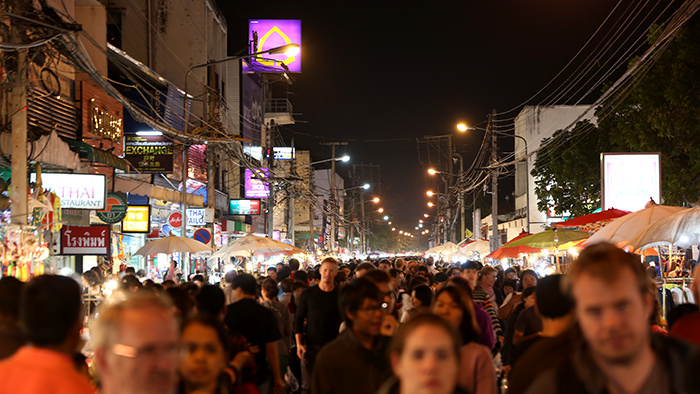
Chiang Mai is known as the “Rose of the North.” Expats from all over the world are seduced by Chiang Mai’s laid back culture, beautiful Buddhist temples, plentiful restaurants, and spirited nightlife. Even if you don’t plan on moving here, you should definitely check out Chiang Mai’s bustling shopping culture. Every evening, the city hosts its night bazaar – a favorite among bargain shoppers. You can browse the clothing, street food stalls, DVDs, jewelry, Thai silk, accessories, and shoes along Chang Khlan Road, east of the old side of the walled city. The scene is pretty much the same every night, with locals and tourists turning up for some delicious street food and people watching. But the best night of shopping in Chiang Mai is the Sunday Night Market, or “Walking Street.”
This market is the largest one of the week, and stretches one kilometer down Ratchadamnoen Road. Unlike the regular nightly bazaar, the Sunday market has more arts and crafts for sale. Thais from neighboring villages come to sell their handmade items. Lanterns, wooden boxes, masks, paintings, and string lights are just some of the things you will see. The Sunday Market also brings local musicians and street performers. Chiang Mai’s Sunday Night Walking Street last from 4 p.m. to midnight. Remember to bring cash and don’t be afraid to negotiate with the vendors.
Elephant Nature Park
When in Chiang Mai, a day at the Elephant Nature Park is an exciting and unforgettable eco-tour for animal lovers. Elephant Nature Park is a rescue and rehabilitation center for abused, elderly, and injured Asian Elephants. What began as a personal quest for Sangduen “Lek” Chailert in 1992 has blossomed into one the world’s most respected elephant sanctuaries. Lek and her team of caretakers, vets, groundskeepers, and volunteers are devoted to ensuring that each rescue elephant lives out the rest of its life in peace and health at the Elephant Nature Park. The herd, currently made up of 30 members, is free to wander the park, bathe and feed at their leisure, as well as interact with park guests.
Visitors will learn about the plight of the Asian Elephant in street begging and logging industry, have the opportunity to observe their natural behavior, feed them, and bathe them in the river. All proceeds from admission go towards feeding the elephants (each one consumes nearly 100 pounds of fresh produce each day!) and general upkeep of the park. This is a fantastic day trip to take with the family or a group of friends. After listening to their stories and witnessing their individual personalities, visitors will come away with a newfound respect for the species, and beautiful memories and photographs. For prices and details about day visits to the park

Thứ Tư, 16 tháng 9, 2015

Food guide in Ho Chi Minh city


Ho Chi Minh City will challenge your perception of proper sidewalk usage: A simple stroll down the street requires dodging parked and moving motorbikes while also tripping over food carts and customers seated in plastic chairs. But the fragrant aromas of grilled meats and simmering soup just might tempt you to abandon any restaurant plans and join them.

The owners of Saigon Street Eats, Barbara, an Australian, and her Vietnamese husband, Vu, specialize in shepherding hungry tourists through their city’s overwhelming selection of street food. Their strategy for choosing might seem counterintuitive. “Paradoxically, if a place looks a bit run-down, it's usually a sign the vendor has been in business a long time and is therefore very good,” Barbara explains. She also recommends seeking places busy with locals. “You should also look for a lot of rubbish on the floor,” she adds “This is a sign of a popular street food place.” The language barrier will ultimately present another challenge, so adventurous eaters should just point at a dish that looks good and go for it. South Vietnam tours packages

Eating at busy street food stalls is also safer from a health standpoint. As most stalls don’t have refrigeration, sticking to freshly cooked or steaming-hot food is a good precaution.  But keep in mind that it's common to get an upset stomach when your diet changes dramatically. “People often think they have food poisoning when their bodies are reacting to a change in their eating habits, often including a lot of cheap beer,” explains Barbara.

Walking through the streets of HCMC, you’ll smell all sorts of wondrous things (and, to be fair, some not so wondrous things) and it’s my hope that by reading through this food guide, you’ll be inspired to seek out those great smells and experience some of the real HCMC’s food scene. PANDAW CRUISE MEKONG

Many people are afraid to try street food when travelling overseas. “How do I know it’s safe?”, “What if I get sick?”, “Is it hygienic?” are a few of the most common concerns that I hear when I discuss street food with people.  I certainly understand why people unaccustomed to street food have these concerns, as the visual image presented to them is very different from what they perceive as being suitable dining conditions. Additionally, everyone knows someone who has had a bad experience.
Food guide in Ho Chi Minh city


Two tips that have kept me in good stead throughout my travels that I’d like to share with you are these:

Eat where the locals are eating.
Look for food that you can see being cooked.
Regarding the first tip, the logic is simple. Generally speaking, food establishments stay in business not because of the tourist trade, but because of the locals that eat there day in and day out. If you come across a place that is busy and full of locals, chances are it’s good. If it was making people sick, it would be neither busy nor full of locals.

In relation to the second tip, most of the street carts and hole in the wall restaurants in Vietnam have the raw ingredients and cooking stations in clear view. If something is being cooked fresh in front of your eyes, you can see for yourself exactly what’s going on. Contrast this to a restaurant with a closed kitchen that you can’t see.

Due to the sheer volume of street food in HCMC, I won’t try to provide you with a fixed guide of establishments, but rather a guide to some of the dishes you’ll find, with a few establishments listed where possible. HCMC is a city that rewards the adventurous eater, and as long as you follow my 2 tips above, you should feel comfortable trying some new things.

Food is being prepared or eaten constantly in Vietnam. These boys were on a side street in an area that was full of mechanics and hardware stores cooking up a soup of some sort.

Rice
Not far from where the boys were cooking, my wife and I saw this man working his magic with the wok. The smell coming from the wok was beautiful and we knew that the only option we had was to try whatever it was that he was cooking up.

One of the things that I love about Vietnamese food is that there’s no set way to eat many of the dishes.  What you will find is that you’ll get a main dish, and then a variety of sauces and condiments to add as you please.

Something that will come as a relief to those of you that don’t like spicy food is that most Vietnamese dishes are mild to begin with. It’s up to you to either keep it mild or make it as spicy as you’d like. The yellow, red and orange chillies below are one of the more common condiments that you’ll find in HCMC.

As is often the case with some of the best street food establishments in Vietnam, the menu is not in English. A mixture of pointing at pictures, or something that looks good on another table is the way to go. In this case, there was one dish that clearly stood out on the menu as being the speciality so that is what we ordered. Broken rice with greens, pork and seafood was what came out and it was delicious.
Com Tam Moc
Com Tam is a simple broken rice dish that is very popular in Vietnam. Com Tam Moc is a chain, and their broken rice is delicious. The menu is in English.
I ordered the Com Tam Bi Cha Thit Nuong Trung Opla, which is broken rice with 3 types of pork and a fried egg. It was very tasty, with my favourite type of pork being the one in the foreground – a mixture of grilled skin and meat.
Coffee
Trung Nguyen
Trung Nguyen is the largest coffee chain in Vietnam, with over 1,000 cafes in the country. When in HCMC, you can’t go too long without stumbling across a branch. Despite being a chain, their coffee is excellent, with a variety of beans produced by sustainable methods, with full descriptions and differing flavour profiles available.

The cafes are very modern and nicely fit out, and free WiFi is available (I was surprised at the extent to which free WiFi is available in cafes in HCMC). Menus are in English and most of the staff speak basic English.

There are a variety of options available, but I always went for the traditional Vietnamese coffee.

When your coffee arrives, it has just begun the process of filtering. The ground beans are in the bottom compartment of the silver filter, with filter holes above, for the hot water to drip through, and filter holes below, for the coffee to drip into the cup.

A few minutes later, the filtration process is complete.  If you asked for your coffee with condensed milk, it is put into the coffee cup at the start.

Traditional Vietnamese coffee is a very tasty, refreshing way of drinking coffee and I was hooked on it during my time in Vietnam.  You can choose whether you want condensed milk or not, and whether you want it hot or cold.

There are a lot of international chains in HCMC these days. Starbucks opened their first store in Vietnam at the start of 2013. This is not that store.
Highlands Coffee
Highlands Coffee is another popular chain that can be found throughout Vietnam. Menus are in English and most of the staff speak basic English.

The coffee here is acceptable, about the same level as a Starbucks.  As well as the usual Vietnamese coffee and espresso options, there is quite a large selection of flavoured options available.  I ordered a Vietnamese coffee with ice and condensed milk, and my wife ordered a green tea latte concoction.  The flavoured green tea syrup is quite a popular option in drinks and desserts in Vietnam.
Albero Cafe
As well as the two major chains, there are a large number of independent modern cafes that can be found throughout HCMC. Albero Cafe was a nice one that I stumbled across. It had a chilled out nature theme, great coffee and free WiFi.
Instead of water, many of the cafes in HCMC serve free iced jasmine green tea (unsweetened) with their coffee.
Albero Cafe can be found at 35 Truong Dinh, District 3.

The place below was not a Trung Nguyen cafe, rather it was a cafe that used Trung Nguyen beans. You’ll see the logo splashed around various cafes and coffee carts throughout the city.

Walking down the street in District 3 on a rainy afternoon, my wife and I stumbled across this alleyway, which seemed quite busy so decided to check it out. Turns out it was coffee that was the only thing being sold so ordering was quite easy. Four English words that almost everyone selling coffee in Vietnam knows are “milk”, “sweet”, “hot” and “cold”. I’d say that 80% of the time we ordered coffee, we got exactly what we wanted.

You’ll find these sorts of spots throughout HCMC and the atmosphere is really great. As a bonus, they are a lot cheaper than an actual cafe if you’re in need of a caffeine fix.
Seafood
Nha Hang Bien Duong.
Nha Hang Bien Duong is a seafood restaurant that my wife and I discovered while walking around the streets of HCMC, taking in the vibe during our first night. There are a lot of tables and seats on the sidewalk, and the place is almost completely full with locals. Not having dinner here was never going to be an option.

The menu is extensive and everything looks really good. One of the waiters spoke very good English and explained a few of the things on the menu for us. The hot pot looked like it was very popular so we went for that. There is a lot of fresh seafood in tanks inside and I got to go to a tank and pick the 2 crabs that I wanted.

Everything came out fresh and our waitress was very good as she showed us how to cook everything and eat it in the correct manner.

We liked the meal so much that we returned on the following night to try some other things. The first thing we ordered was a vegetable and mixed seafood hotpot with a dried rice cake that became soft once the liquid was poured over it. I lost some of my photos from this trip an unfortunately the photo of this dish was one of those.

The next thing we ordered were little sea snails that you see all over HCMC in restaurants and on street carts. They were served in a coconut butter and the safety pins were used to get the snails out of the shells. They were very tasty.

Looking at the menu, it looked like there were 3 Nha Hang Bien Duong restaurants in the HCMC. The one that my wife and I went to, which is very central, can be found at 45 Nguyen Thai Hoc, District 1.

Banh Mi
Banh mi is one of the foods that people commonly associate with Vietnam and is a delicious snack that shows how fusion food, when done right, can be brilliant. Banh mi is actually the Vietnamese word for all kinds of bread, which was introduced to the country by the French. The food that most people in the West refer to as banh mi is actually banh mi, followed by other words denoting the type of sandwich. In the case of the stall below the offering was banh mi (bread) with pa te (pate) and thit (meat).

The meat is usually some kind of steamed or roasted pork belly, grilled chicken, Vietnamese sausage, or other pork related meat. Usual condiments include pate, sliced cucumber, coriander, pickled carrots and shredded daikon. Common condiments include chilli sauce, sliced chillies, mayonnaise and cheese.

Stalls selling banh mi can be found throughout HCMC. Have a look at the ingredients and if it looks good, go for it. Pointing is generally the way to choose your fillings. I like to get mine with “the lot”. For the freshest bread, eat banh mi in the morning or early evening.
Rice Paper Rolls
Rice paper rolls are another dish that many people outside of Vietnam associate with the country. They are very common throughout HCMC, and my wife and I found this great little place at 91 Cach Mang Thang 8 Street, District 1.

The rolls are prepared fresh out the front, with a seafood and pork option. Dipping sauces include a peanut sauce containing hoisin sauce, and nuoc mam pha, which is a mixed fish sauce. A simple and delicious snack.

Noodles
HCMC’s District 4 contains a wealth of great food options, with prices even lower than they are in District 1. Ton That Thuyet is the street that you want and early morning around 7AM is the best time to go, as this is when the food is plentiful (when it comes to many of the smaller, family run food establishments in Vietnam, the food is not necessarily available all day long).

Many of the popular dishes covered elsewhere in this post are available in the area, however one stand out was Hoa Hanh at 183 Ton That Thuyet.

As well as banh mi, there was another dish that was being served at Hoa Hanh. The menu was not in English and nobody spoke English but a quick glance at the other tables revealed that this dish was the one to get. We pointed to another table and soon after, two bowls of this arrived.

A rather sweet soup with thick, udon-like noodles filled with large mushrooms and some sort of meat is what’s contained in the bowl. To top it off is a semi-soft egg type “something”. What I know for sure is that it’s a very hearty and tasty dish.

Everywhere you go in HCMC, someone is doing their own take on a dish. The differences are subtle, but they are there and over time you start to get a real appreciation of the variety and complexity of Vietnamese food.

At this hole in the wall in District 1, soy sauce, fish sauce and chilli were on the table, awaiting a meal that they could be added to.

My wife and I ordered almost the same thing, the difference being the noodles. Herbs, meat, mushrooms and sausage were combined in the soup and it was topped off with a fried wonton.

When it comes to many of these small, hole in the wall food establishments in Vietnam, the ingredients are cooked right out the front on these small cooking stations.

Pho
Finally, we get to the one dish that most foreigners associate with Vietnam, a noodle dish that is deserving of its own heading.

Pho is a noodle soup consisting of broth, flat rice noodles, herbs and meat (usually beef or chicken). The quality and style of pho varies quite a bit between vendors. I chose to get the Pho with beef brisket.

My wife and I ate pho at a few places, but by far the best that we had was from the “lunch lady”. Despite the fact that the lunch lady has a reputation for making amazing pho, and has been featured on Anthony Bourdain’s “No Reservations”, there was not a foreigner in sight when we visited. This could have something to do with the fact that while the lunch lady is in District 1, the location is not obvious.

Pho is served with a variety of condiments and sides, exactly what you’ll get depends on the vendor. Below is a fairly typical selection of limes, chillies, mint and basil, as well as a variety of sauces to the side.

One sauce that I discovered in HCMC that I loved was a sweet chilli sauce. Unlike the watered down sweet chilli sauce that’s typical in Western countries, this sauce sweet, but also properly chilli. It’s also a lot less thick in its consistency.

The flavour of the broth of the lunch lady’s pho is out of this world. She opens up around 11AM, and only has a limited quantity of food. Once it’s gone, that’s it for the day. This pho was one of the best things that I ate in Vietnam.


The lunch lady can be found at 23 Hoang Sa Street, District 1.

Dessert
Che My 2
Che My 2 is a hole in the wall that sells a variety of desserts and snacks. “Che” is the Vietnamese word for “sweet soups”. Options consist of a mixture of ingredients such as shaved ice, ice cream, jelly, tapioca pearls, fruit, coconut, condensed milk, sweet beans and the like in a bowl or cup. The menu is not in English, so pointing at what looks interesting on the menu is what you’ll be doing here. It’s worth it, as the desserts are delicious.

Unfortunately photos of the desserts at Che My 2 were amongst those that were lost so I can’t show you what we ate.

There are 2 Che My 2’s in HCMC, the central one is at 119 Nguyen Thai H?c, District 1.

One drink that is very common in HCMC is sugar cane drink. My wife and I were walking down a street in District 3 when it started raining quite heavily. Needing a respite from the rain, we ducked into this place as it was quite busy.

Nobody spoke English apart from one man, who only knew how to say “sugar cane”. Why not? we thought, and this is what came out a short while later, along with the ubiquitous iced jasmine tea on the side. It was very sweet, and very refreshing.

You’ll see machines set up on the streets of HCMC, with operators pushing large pieces of sugar cane through the machine, which extracts all of the liquid from the stem. It’s a very common drink in the city.

Anybody that knows my wife and I knows how much we love bubble tea. For the uninitiated, bubble tea is a Taiwanese tea based drink served with a wide array of flavourings, tapioca pearls or jelly, with the option of milk or no milk. Bubble tea is about as common in HCMC as it is in Australia or the United States.

Below is one with lychee flavour and grass jelly, and grape flavour with green tea jelly.

Street Carts
Throughout HCMC you’ll see men and women pushing around portable street carts. sometimes they’ll be selling one kind of fruit, or something else simple and other times they will be pushing around what is essentially a small cooking station with a few shelves. Many of the drinks and dishes that I’ve described above can be found on these roaming street carts.

The woman below was selling coconuts to drink from just outside of the Ben Thanh Market in District 1.  You should expect to pay anywhere between VND25-50 for a coconut in the main parts of HCMC. Some opportunistic vendors in touristy areas try to sell them for up to VND250 each, and then offer you a “special price” of VND250 for 2. Make sure you don’t get ripped off by these guys and stick to your guns when negotiating the price down.

The same thing goes for fresh fruit vendors, who can also be found throughout HCMC. After spending half a day in District 3, and getting some amazing fruit, such as rambutans from the vendor below, it was quite shocking to see what some of the vendors in the more touristy parts of District 1 were trying to charge foreigners!

Just like everywhere else in the world, food and dinner is what brings the family together. Unlike many of the other places that I’ve travelled to, this family got together for dinner on this busy street corner every night.

I hope that this post has given you some ideas on how to take on the food scene in HCMC. There is a lot of amazing food to be found in the city, ranging from the familiar to the unfamiliar.

There aren’t too many places in the world where you can get such a wide variety of amazing food for so cheap. The average price we paid for a meal for 2, with drinks in HCMC was about USD$5.  The cheapest was about $USD3, and most expensive, when we “splurged” at the seafood restaurant was about USD$20.

Feel free to get involved in the discussion in the comments section below. I’d love to hear of any experiences and recommendations that you might have. I would also very much like to find out the names of some of the dishes are that I haven’t got names for.